Home/Planner Insight Blog/Blog Details


September 25, 2025
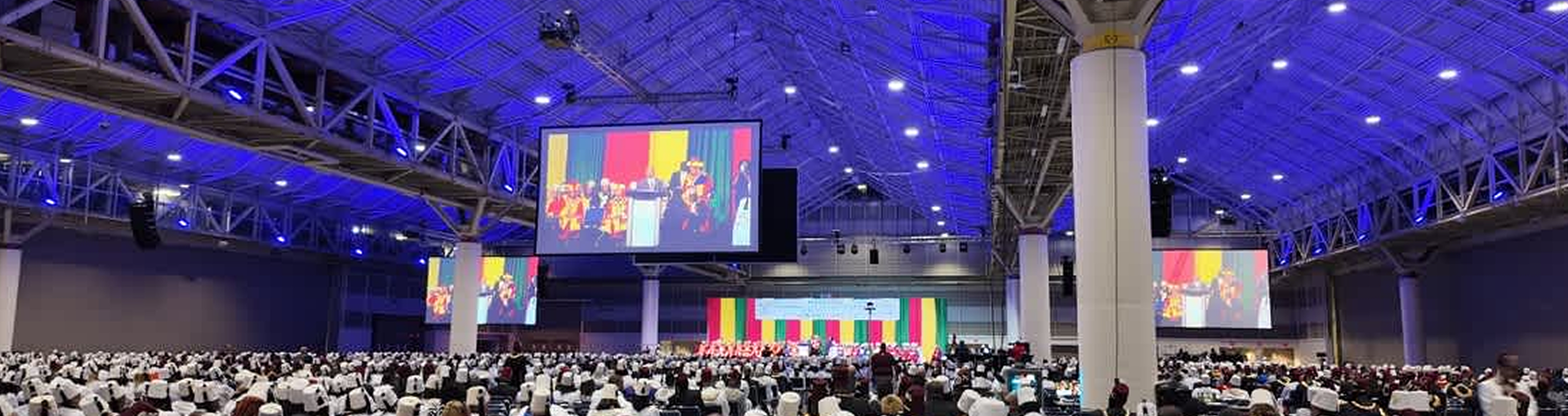
The loading dock is jammed, crates of truss gear and coils of fiber-optic cable stacked like live ammunition. Inside the convention center, someone shouts about a corrupted media file. Overhead, a 40-foot LED wall blinks, stutters, then dies to black. A voice crackles over the comms, sharp and controlled, “Patch C6. Reroute through backup. I want eyes on every floor monitor at ten.”
It’s 6:32 a.m. in Florida. The show opens in five hours.
By then, every LED pixel must sync with the motion graphics. Every mic, every spotlight, every live cue needs to hit with exact timing. The CEO steps out to applause, not static. The music rises on cue, not by chance. There is no dress rehearsal, no safety net.
Just as the control booth starts to stabilize, a new alert hits, one not on any checklist, timeline, or contingency plan. Something crucial is missing, and nobody knows where to find it.
The title reads event production manager. The reality is something else entirely. Engineer. Therapist. Air traffic controller. All at once, often within the same hour.
One moment is spent fine-tuning audio latency across a dozen wireless channels. The next, it’s calming a client whose keynote speaker just missed a flight. Behind the scenes, this role is the hub, moving people, machines, schedules, and storylines through layers of complexity that never pause.
Digital Xperience Group works across the U.S., known for experiences that fuse real-time immersion with technical precision. Our shows stream live, scale fast, and carry the weight of multimillion-dollar brands. Stakes are high. Tolerance for delay is zero.
The production manager drives that machine. No second chance, no do-over. Every move is planned, adjusted, executed in motion. Every mistake echoes. Every success vanishes the moment the lights go dark.
Before anything works on show day, it has to survive the build..

The work starts long before the freight arrives. Weeks out, screens are still black, however, the infrastructure is already in motion.
Zoom grids fill with vendor leads, designers, and engineers locked into timelines that cannot move. CAD diagrams sprawl across shared drives, mapping cable runs and rigging points with the detail of architectural blueprints. Speaker onboarding sessions double as brand protection drills, fine-tuning tone, cadence, and transitions down to milliseconds.
Every system speaks to another. Asana handles the flow. Vectorworks maps the ground. vMix choreographs the stream. QLab locks the cues. The stack runs deep, wired for real-time control, redundancy, and remote diagnostics.
Each layer gets tested, then tested again. Signals are simulated. Failovers are triggered on purpose. If something breaks, it has to happen here, not later.
Nothing hits the floor cold. Every element gets touched, tagged, rehearsed, and tracked. Once the trucks unload, the window closes. Execution takes over.
And everything accelerates.
By morning, the room is alive with anticipation and precise chaos. Screens hum as processors boot, trusses lock into place, and cables snake across the floor like controlled veins, hidden under tape and protective mats. Doors remain closed, yet every heartbeat in the space is synchronized to the clock.
Sound engineers isolate channels, adjusting frequencies while testing acoustics across every row.
Microphones are calibrated, color-coded, and mapped to multiple inputs.
Lighting operators adjust intensity, temperature, and focus to match cues that allow no error.
Cue sheets are annotated in real time, scripts fine-tuned for pace, timing, and sudden shifts.
Each adjustment, each note, becomes a stitch in an invisible safety net.
Client walkthroughs feel like inspections of trust.
Questions probe for certainty:
Will visuals align with the narrative?
Will the stream hold if bandwidth fluctuates?
Teams respond with gestures, head nods, and rapid comms chatter, translating protocol into immediate action.
Then disruption strikes:
A speaker cancels.
A media file fails verification.
A projector displays the wrong input.
Hands move swiftly across control boards, rerouting feeds, switching playback, patching signals without hesitation.
Contingency protocols, Plan B and Plan C, activate seamlessly, rehearsed long before show day.
The space shifts from rehearsal to performance in a heartbeat.
Doors open, and the audience floods in, unaware of the invisible precision operating behind the scenes.
Every cue executes in real time, every transition calibrated to perfection. The room pulses with energy, yet only those behind the panels and screens feel the tension release, the surge of adrenaline, and the quiet satisfaction that the show is both running and alive.

Every live show looks like tech, on the other hand, it runs on people.
In the booth, operators track timelines with precision.
Audio, video, lighting, graphics, each led by a specialist, all synced to a master cue.
Backstage, teams manage mic swaps, transitions, and walk-ons without breaking flow.
On comms, a private language moves between departments, fast and silent to the crowd.
Signals and alerts travel in milliseconds, solving problems before they surface.
The culture is clean. Fast decisions, short responses, zero hand-holding. Every crew member knows the chain, the tempo, the fallback. Everyone trains for calm under pressure. One missed beat and the whole system shifts to cover it without a visible crack. Trust is built through repetition, through experience, through an almost instinctive understanding of each role.
Digital Xperience Group runs its teams with intent. Roles are locked before boots hit the ground. Etiquette is codified. Execution flows like code, modular and scalable. Respect is baked into the silence between calls. Instructions are often nonverbal. A glance, a nod, a hand gesture is enough.
What they’re building only works if every part moves together. And soon, it all has to come apart, dismantled, packed, and ready for the next challenge, each step requiring the same precision as the show itself.
Visit these posts to understand more about event production

The crowd rises. The final slide fades. Lights drop to black. In the room, it feels like a finish. On comms, it’s just another cue.
Within minutes, cases roll out. Cables come up. Labels go on. The same hands that built the show now dismantle it in reverse, faster, quieter, carrying the weight of exhaustion even without the pressure of a countdown clock. Every cable, every fixture, every microphone has a designated place, a sequence, a protocol to ensure nothing is lost or damaged.
There is no toast, no spotlight, no moment, just gear checklists, freight schedules, and the ritual of making it all disappear as cleanly as it arrived. Trucks rumble outside. Crew members trace their steps across the darkened hall, marking each pallet, each rig, each monitor for the next event.
The paradox holds. When everything works, no one notices. That’s the point. Silence means success. Still, the charge lingers. Not from the tech, not from the applause. It comes from knowing every decision, every adjustment, every microsecond of preparation made this possible.
And before the dust settles, before the lights flicker back on anywhere else, the next production already waits, drafted, schemed, and ready to be executed with the same invisible precision.
Live production is no longer confined to stages. Digital Xperience Group is engineering a shift, one where audiences engage across layers of digital, physical, and augmented space in real time.
AR overlays extend beyond LED walls, bringing data, visuals, and speaker presence into immersive motion. AI handles cue management, optimizing show flow by reacting to real-world delays and inputs without human lag. On hybrid platforms, analytics now track engagement down to device type, dwell time, and click velocity.
This is all about infrastructure. DXG is investing in systems built to scale without friction. Modular builds. Remote diagnostics. Power-conscious rigs. Every element is designed to reduce waste, latency, and failure points.
The future is a live experience redefined, mobile, responsive, intelligent.
To see how Digital Xperience Group can build it for you, contact us.